
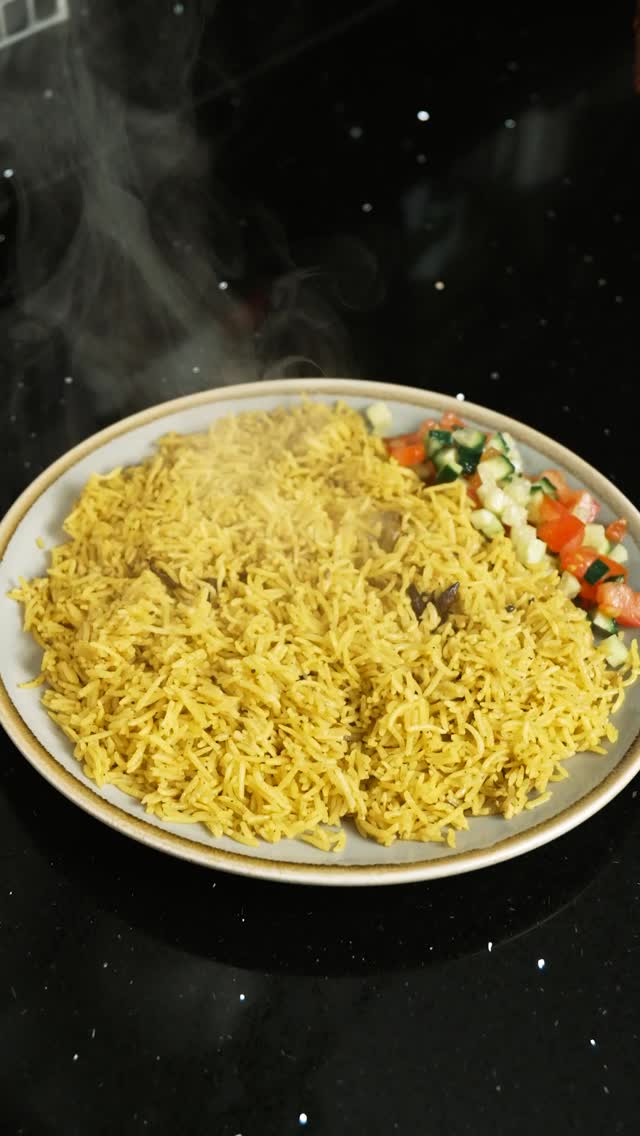
Biryani is the dish that starts arguments. Every family has the definitive version. Every region has its own claim. Every cook who has made it properly — really properly, the long way, the right way — knows that the difference between a great biryani and a mediocre one comes down to a handful of decisions made at exactly the right moment. There is no room to hide in a biryani. Every stage of it is visible in the finished dish.
This post is not a recipe. It is an account of what biryani actually requires, written by people who make it seriously, so that the next time you order one at Raavi Spice — or anywhere else — you understand what went into it.
The Rice: Age Matters
Long-grain basmati rice, aged for at least one year, is not a preference — it is a requirement. Fresh basmati has a higher moisture content and a different starch structure. When cooked, it tends to become sticky and the grains clump. Aged basmati has had time for its moisture to reduce and its starches to change. When cooked correctly, the grains stay completely separate, each one distinct, each one carrying its own flavour.
We source our basmati specifically for biryani. We taste it before buying, because rice varies significantly even within the aged basmati category, and a biryani is only as good as its rice. This might seem excessive. It is not. The rice is half the dish.
Before cooking, the rice is washed three times to remove excess surface starch, then soaked for thirty minutes. This pre-soaking reduces the cooking time and ensures the grains are uniform in texture. Unsoaked rice cooks unevenly — some grains become overcooked and break while others remain hard in the centre. The soak removes that variable.
The Meat Marinade
The meat — lamb, in our case, bone-in pieces for the marrow — is marinated for a minimum of four hours. Ideally overnight. The marinade is yoghurt-based, which does two things: the acidity tenderises the meat fibres, and the protein in the yoghurt helps the spices bind to the surface of the meat rather than washing off during cooking.
Into the marinade goes garam masala, red chilli, turmeric, ginger paste, garlic paste, fried onions (birista), and fresh mint. The mint is not optional — it is one of the flavours that defines Pakistani biryani and distinguishes it from the Hyderabadi and Kolkata styles. When you lift the lid of a dum pot and smell mint rising with the steam, you know it is going to be right.
The Birista: Forty Minutes of Patience
Birista — deeply caramelised onions — are the soul of a Pakistani biryani and the element that most shortcuts destroy. They are made by slicing onions very thinly, then frying them in oil over medium heat, stirring constantly, for thirty to forty minutes until they are a deep mahogany brown and have reduced to approximately a quarter of their original volume.
This is not 'cook the onions until golden'. That takes five minutes and produces a completely different result. Birista takes forty minutes and produces a sweetness, a depth, and a colour that cannot be replicated any other way. Commercial biryani mixes include dried fried onion — it is not the same. Pre-made birista from jars — not the same. There is no alternative to standing at the stove and watching onions slowly transform over real heat.
The birista is scattered over the rice layers before the pot is sealed. It dissolves slightly during dum cooking, flavouring the steam and colouring the top layer of rice to the characteristic golden-brown that a proper biryani should have.
The Dum: The Defining Technique
Dum cooking is what separates biryani from a rice dish with curry on top. The word 'dum' comes from the Persian for 'breath' or 'steam', and it refers to the technique of sealing the pot completely and cooking over very low heat so that the food cooks in its own steam without any steam escaping.
The layering happens before the seal: meat goes on the bottom of the pot, then a layer of par-cooked rice (cooked to about seventy percent doneness), then saffron-steeped milk for colour, then birista, then fresh mint and coriander, then the second layer of rice, then more saffron. The pot is then sealed — traditionally with a rope of dough pressed around the lid — and placed over a very low flame. A heavy tawa (griddle) is often placed under the pot to distribute the heat and prevent the bottom from burning.
At Raavi Spice, we seal the pot with dough. The seal breaks during cooking as steam pressure builds inside, but by the time it breaks, the cooking is nearly complete. The moment of opening the pot at the table — the rush of fragrant steam, the sight of the saffron-stained top layer — is one of the most satisfying moments in cooking. Nothing is better.
The Whole Spices
Bay leaves, black cardamom, green cardamom, cinnamon sticks, star anise, cloves, and mace go into the oil before the meat, before the onions, before anything else. They bloom in the heat, releasing essential oils that infuse the cooking fat and form the aromatic base of the entire dish. These spices should be removed before eating — they are flavour vehicles, not food, and biting into a whole clove mid-meal is unpleasant.
The combination of these whole spices is what produces the particular aroma of Pakistani biryani — warm, complex, slightly sweet, and completely impossible to replicate with ground spice blends.
What You Are Actually Ordering
When you order a biryani at Raavi Spice, you are ordering something that took the better part of a day to prepare. The marinating, the birista, the par-cooking of the rice, the layering, the sealing, the dum — none of it is fast and none of it is easy. Every element matters. We make no apologies for the time it takes to arrive, because what arrives is worth the wait.
Come and let us make you a proper biryani. Reserve a table at Raavi Spice in West Drayton, and order the one you have never quite been able to find anywhere else.
Experience the Flavors
Inspired by our stories? Join us at Raavi Spice to experience the authenticity of our cuisine firsthand.
More Stories from Raavi Kitchen
The Art of Authentic Spice Blending: Why Freshly Ground Spices Elevate Every Dish
Discover how whole spices, traditional dry-roasting, and daily in-house grinding form the foundation of West Drayton's finest Punjabi and Lahori cooking.
Summer Flavours & Al-Fresco Dining: What Makes Pakistani Grills Perfect for Warm Nights
Discover how charcoal-grilled seekh kebabs, lamb chops, and fresh tandoori naan create the ultimate summer dining experience in West Drayton.